- 0
- 0
- 0
分享
- A Century-old Legacy Across Time and Space
-
原创 2021-10-20
“The Versatile Master:
Research Exhibition of
Ren Bonian Paintings in CAFAM Collection”
The Shanghai School of Painting occupies an important position in the history of modern Chinese fine arts, within which Ren Bonian is regarded as a great master who invents the future while building upon the past. “The Versatile Master: Research Exhibition of Ren Bonian Paintings in CAFAM Collection” was unveiled at CAFA Art Museum (abbr. CAFAM) on September 18, 2021, which showcases the historical perspective and unique achievements of this “genius” artist in the process of developing Chinese paintings from traditional modes to a modern transformation.

Ren Bonian, Amitabha Buddha
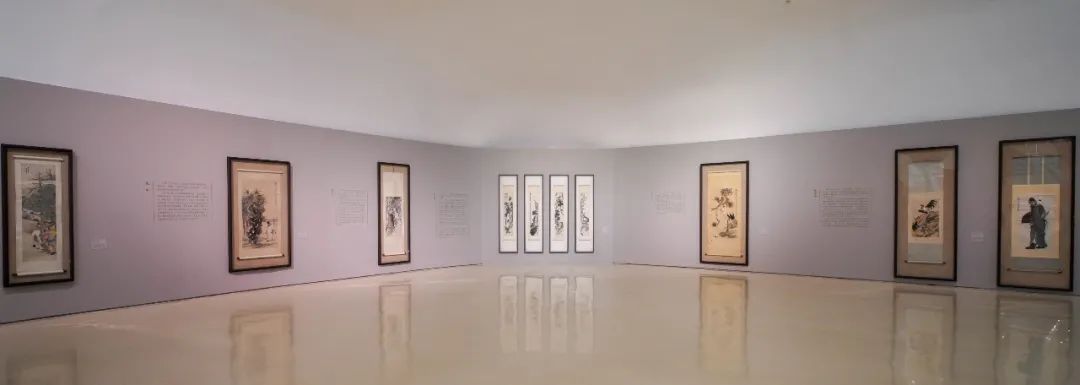
Under the influence of his father Ren Hesheng who earned his living as a rice trader, Ren Bonian had already established a good eye for details, and outstanding sketching skills in his childhood, but he did not become a professional artist until he learned from Ren Xiong and Ren Xun. His early painting style was influenced by the heritage of Chen Hongshou, and even the double hook method of the Song dynasty painters. Later he absorbed Bada Shanren’s skill of “centered tip of a brush held from a suspended wrist” and Hua Yan’s original philosophical thinking, then he gradually formed his own artistic style. The first section of this exhibition, “Learning from Tradition” includes highlights of these masters who have influenced Ren Bonian's development. Ren Jin, a son of Ren Bonian pointed out that Ren Bonian had learned from Chen Hongshou in the inscription of a small-size “Amitabha Buddha” by Ren Bonian at the entrance of this exhibition. While Fei Danxu’s “Red Dress in Snow” represents the portrait painting of the elegant lady that Ren Bonian (alias Xiaolou) pursues in his early years. Ren Bonian started to learn from Zhu Da when he was middle-aged, the full composition and refined strokes that Zhu Da was expert in, reflects the direction that Ren Bonian developed in his later flower-and-bird paintings.
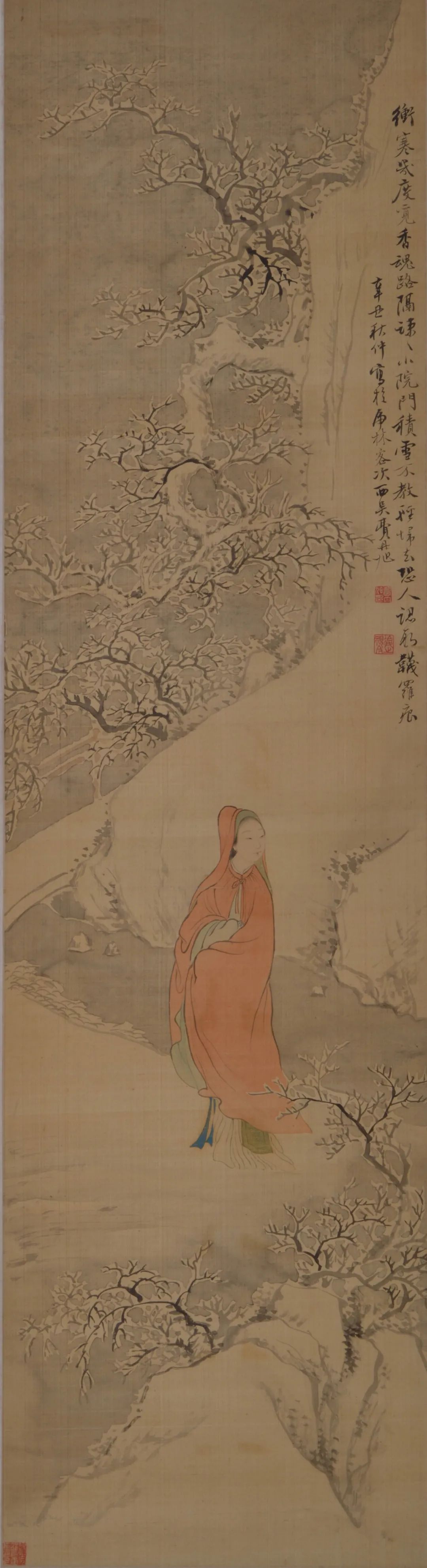
Fei Danxu, Red Dress in Snow, Qing dynasty, ink and color on silk, 123×33cm

Chen Chun, White Lotus (scroll), Ming dynasty, ink and color on paper, 50.7×27.3cm
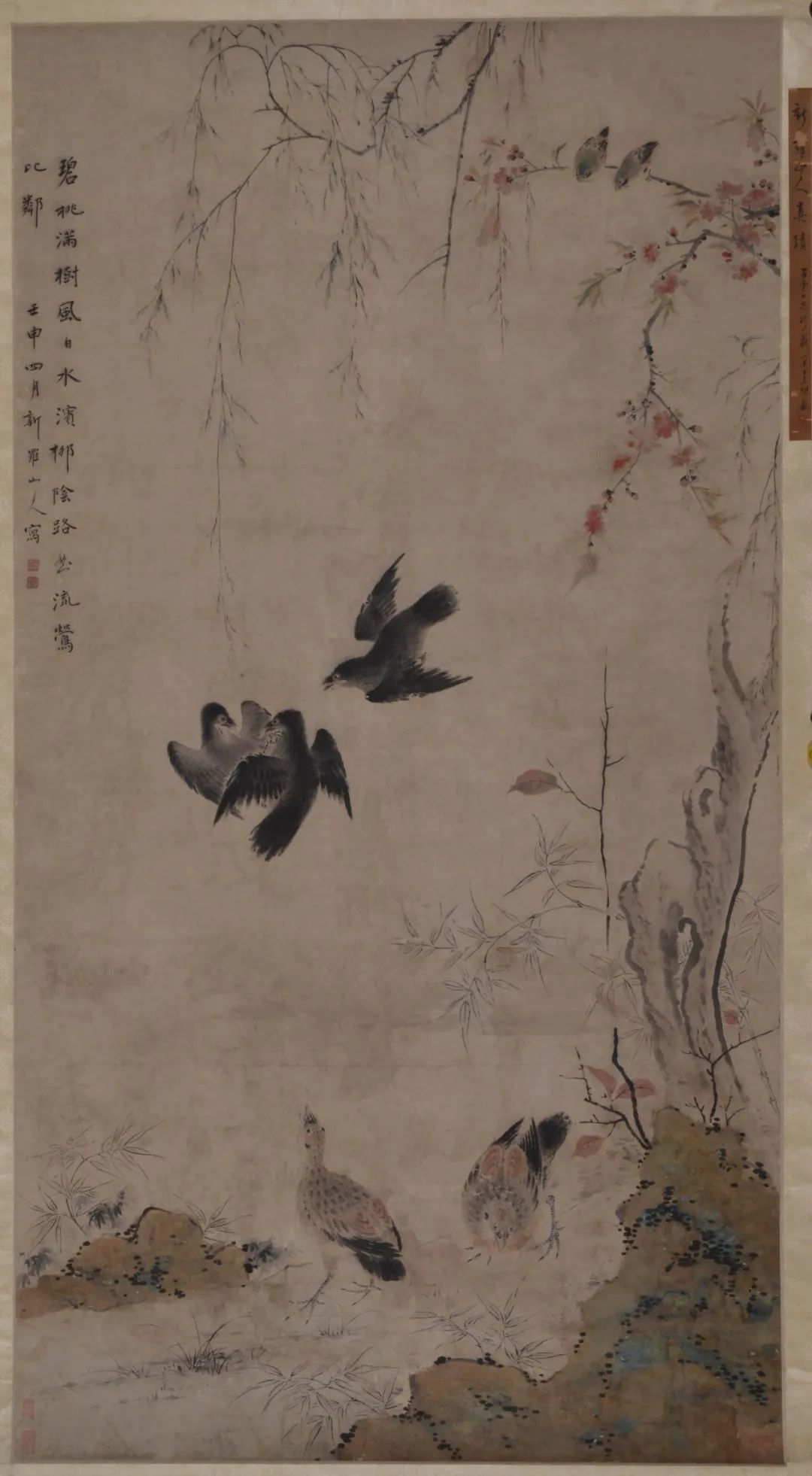
Hua Yan, Birds Gathering under Willow and Peach Blossoms (scroll), Qing dynasty, ink and color on paper, 172.5×93cm
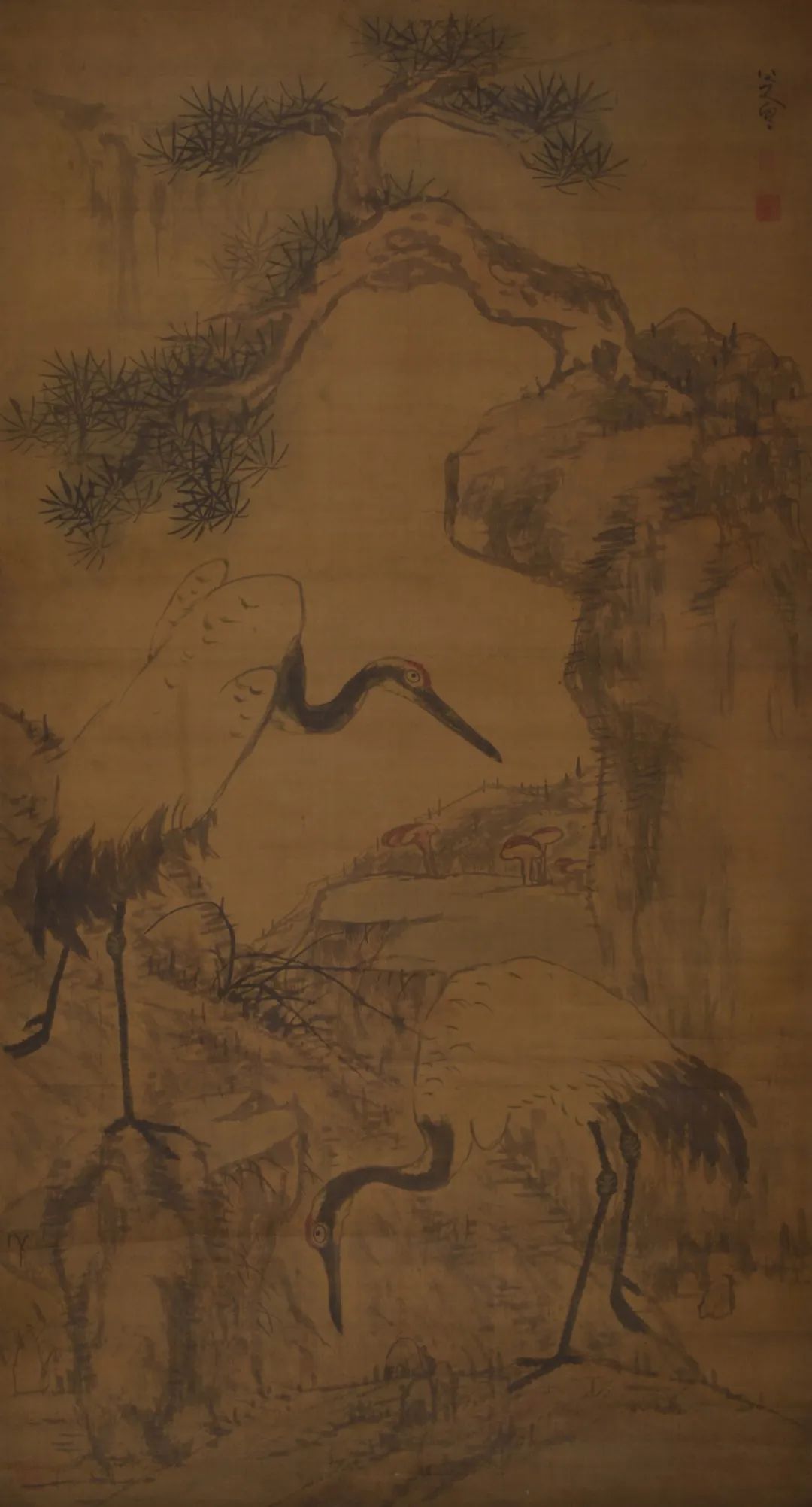
Zhu Da (Bada Shanren), Pine, Crane, Iris and Stone (scroll), Qing dynasty, ink and color on silk, 188×102cm
Being an iconic figure in the early and later transitions in the Shanghai School of Painting, Ren Bonian also inherited the characteristics of senior painters in this school, especially two predecessors, Ren Xiong and Ren Xun, together are regarded as the “Three Ren in Shanghai School of Painting.”
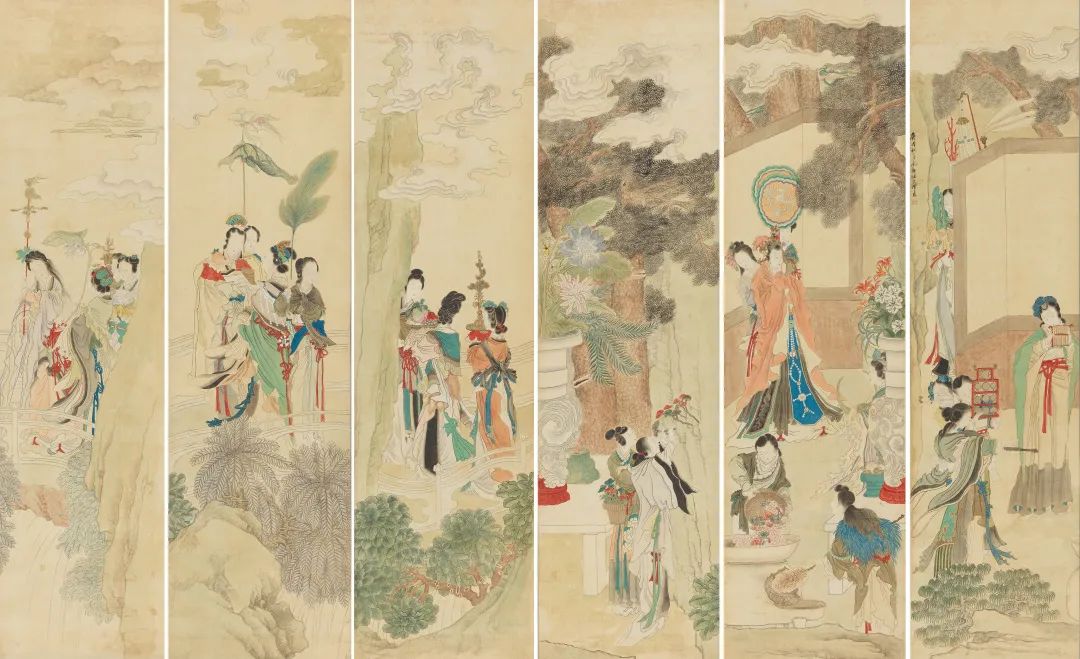
Ren Xiong, Offering Longevity, 1850, ink and color on silk, 172×280cm
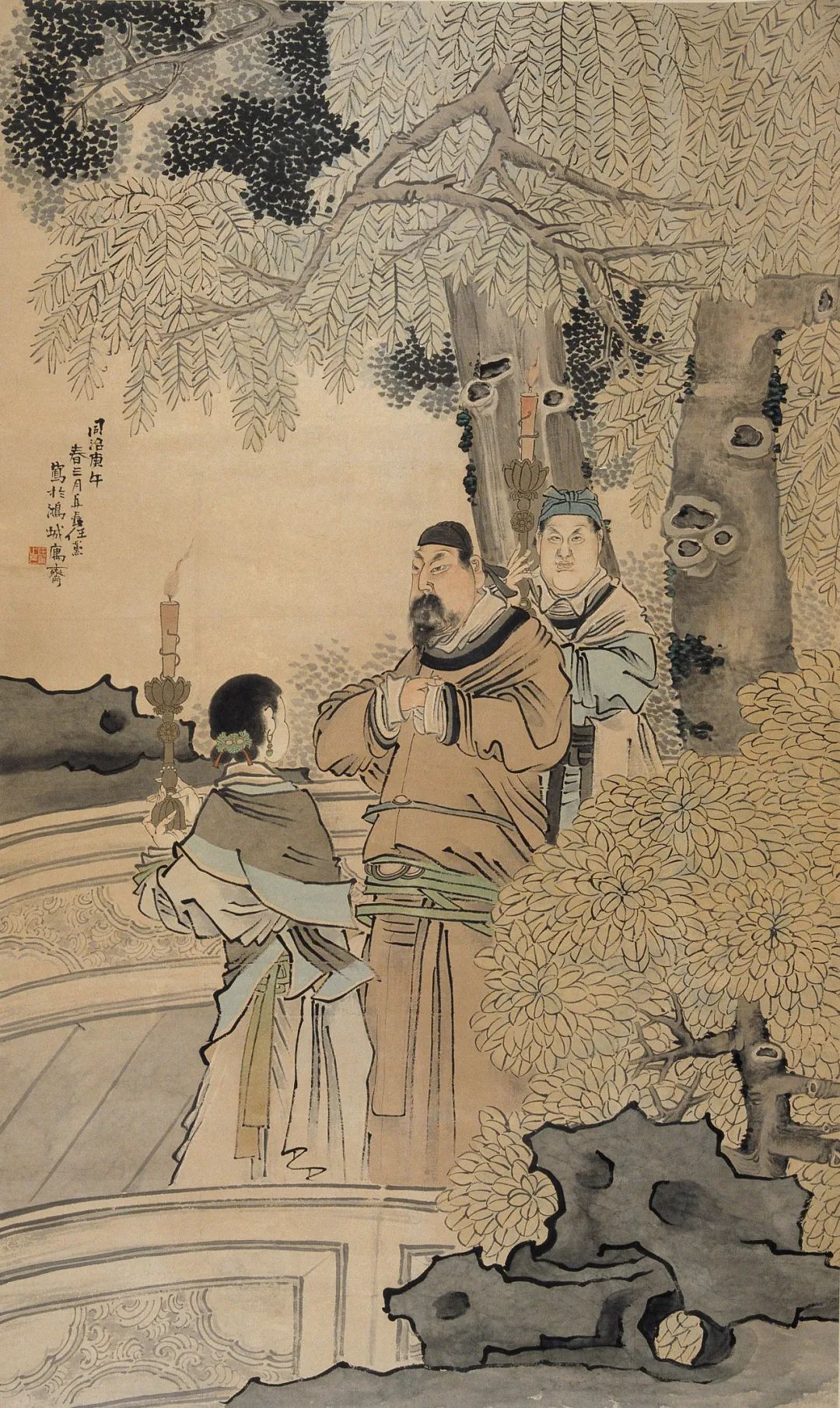
Ren Xun, Holding Candles, 1870, ink and color on paper, 204×121cm
“An Outstanding Artist of His Time” as the second section of this exhibition retrospects the oeuvre of Ren Bonian with 40 (series)of paintings from various periods and fields that reveal the diversified development of this “genius” in the Shanghai School of Painting. His figure paintings combine meticulous painting with figurative depictions, in a more expressive and straightforward way, they reflect the manners and expressions of figures. “The Portrait of Heng Yun Shan Min While Begging” reflects Hu Gongshou, who was already well-known in the painting circle of Shanghai at that time. Hu often wrote inscriptions for Ren Bonian’s paintings and they usually collaborated on creations. Hu supported Ren and helped him to get a firm foothold in Shanghai. In a meticulous way, Ren Bonian outlined the facial characters of Hu and drew a cloth gown. In the basket that Hu holds there are book scrolls and plum sticks, which indicates the typical seclusion of traditional Chinese literati, and further reflects the painter’s respect for this benefactor. Another “Portrait of Yicheng”, outlines the figure with a few strokes, which comprehensively conveys the characteristics of Ren Bonian’s portrait paintings. Among the themes such as “Portrait of Zhong Kui” which is popular in folk culture (it is usually hung on the day of the Dragon Boat Festival), we can find the slick strokes and three-dimensional effect of the rendering effect, which reflects how Ren Bonian as a painter of Shanghai School meets the needs of the painting market at that time.
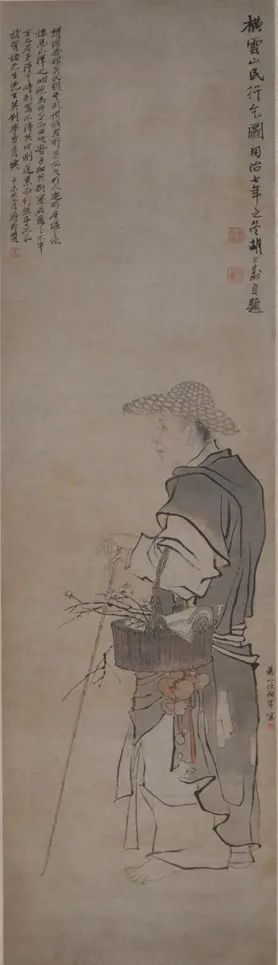
Ren Bonian, The Portrait of Heng Yun Shan Min While Begging (scroll), 1868, ink and color on paper, 147×42cm
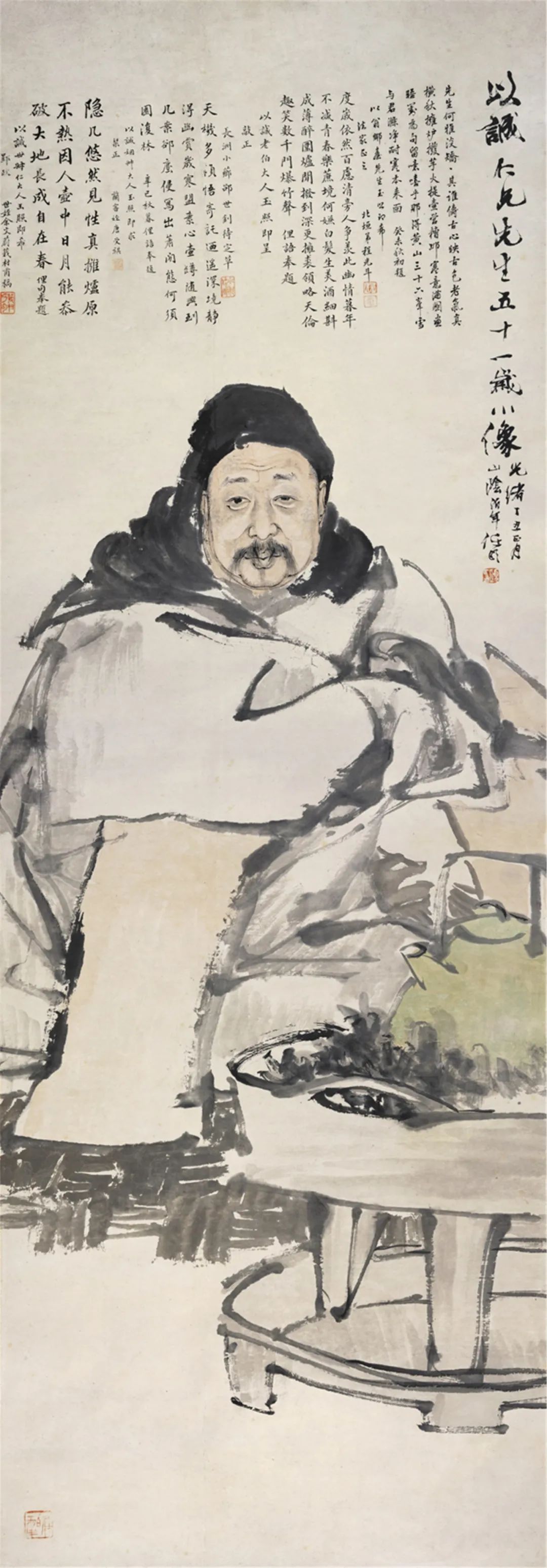
Ren Bonian, Portrait of Yicheng, 1877, ink and color on paper, 102 ×45cm
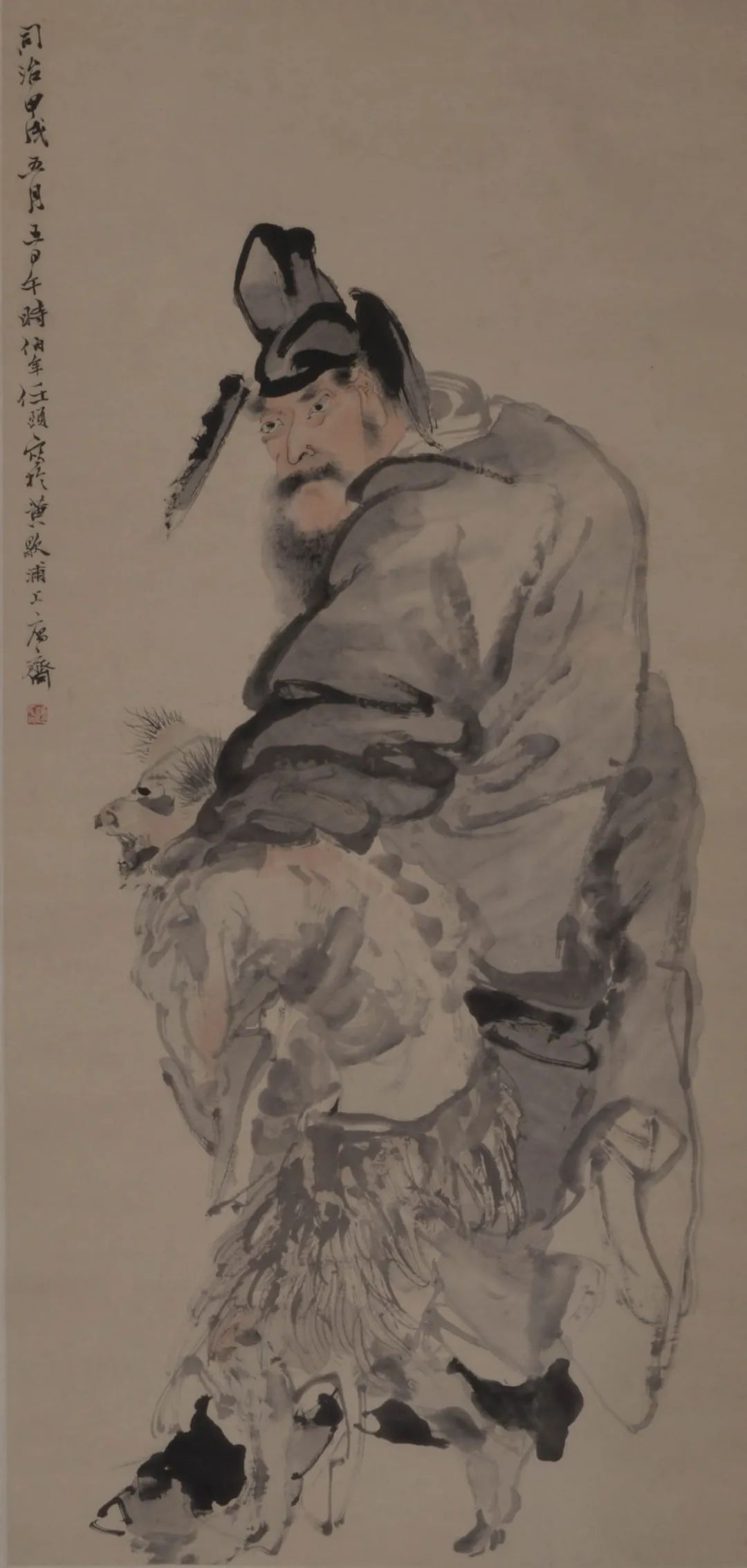
Ren Bonian, Portrait of Zhong Kui, 1874, ink and color on paper, 135 ×64cm
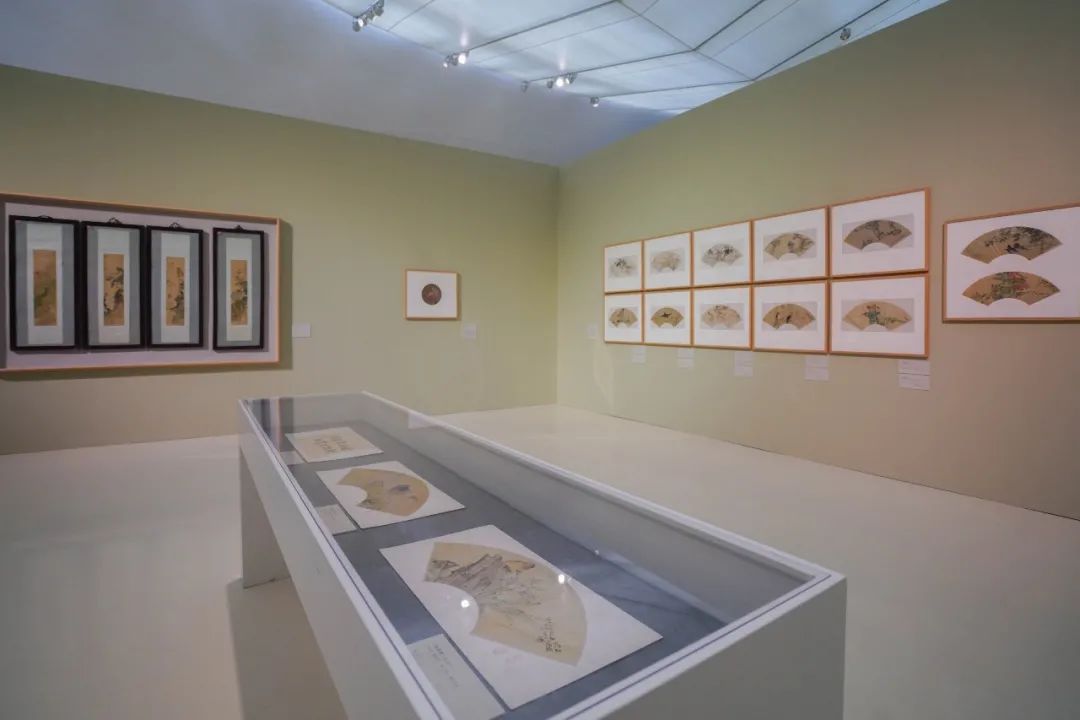
Flower-and-bird paintings constitute an important part of Ren Bonian’s oeuvre. A series of fans painted by Ren Bonian are also displayed in the exhibition hall. When he arrived in Shanghai, it was Hu Gongshou who found a job for him in the Fan Shop of Guxiangshi. Various kinds of sprinkled gold, lacquer and satin fans, in addition to imitating the styles of Chen Hongshou and painters in the Song Dynasty. These paintings depict plum blossoms, peonies, roses, orchids, chrysanthemums, loquats, camellias, parrots, sparrows, starlings, wax finches, herons, black-bone chickens, waxwing birds and so on, they are mostly vivid gestures captured by Ren’s careful observation of life, as they jointly reflect his passion for the vibrant natural world. “Phoenix Dwells the Old Green Parasol Tree Branch” shows his state when he aged. It was painted in 1889 when he suffered from poor health and pain due to long-term addiction to alcohol and tobacco.
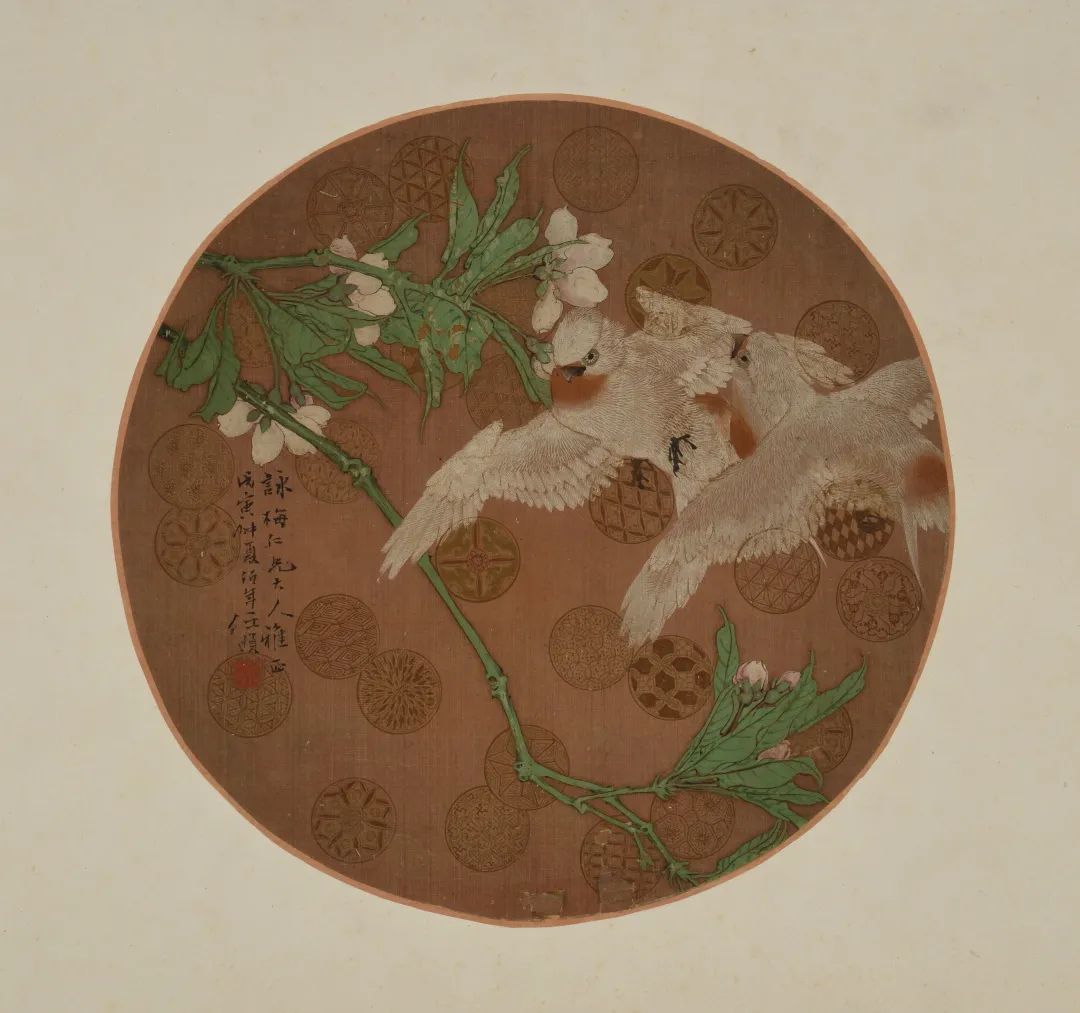
Ren Bonian, White Parrot, 1878, Ink and color on satin fan, Diameter 28.5cm
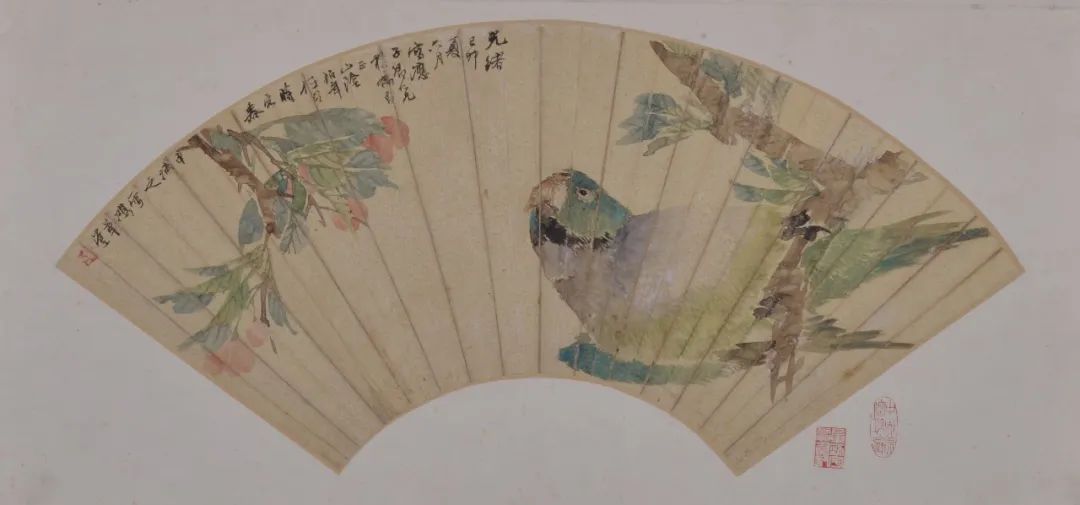
Ren Bonian, Fan IV, 1868, Ink and color on paper, 29×58cm

Ren Bonian, Phoenix Dwells the Old Green Parasol Tree Branch, 1889, Ink and color on paper, 227×114cm
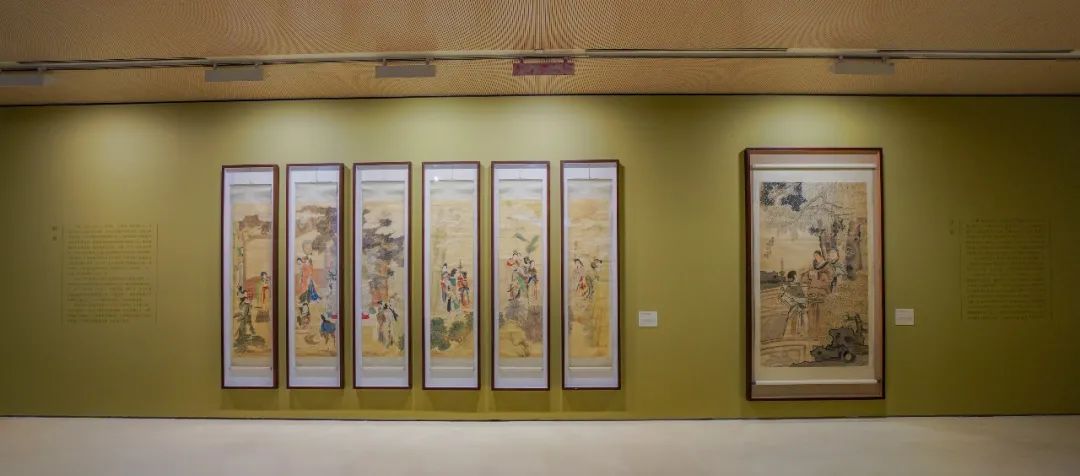
Ren Bonian has inspired many painters following his generation. His oeuvre was a milestone for the revolution of Chinese painting, and also deeply influenced Chinese painting in the 20th century. Mr. Xue Yongnian once commented that Ren’s work “learning from the tradition while absorbing the west.” Ren could acutely observe the new artistic concepts, and search for an original art language. This is also how China is seeing traditional Chinese culture now: it encourages the dialectical review of tradition and active development of new art styles, “using the ancients’ rules to make our own world.” Another set of Quad Painting features stories of figures, excels in ingenious composition and rich details, which highlights how Ren deals with obviously important commercial tasks.
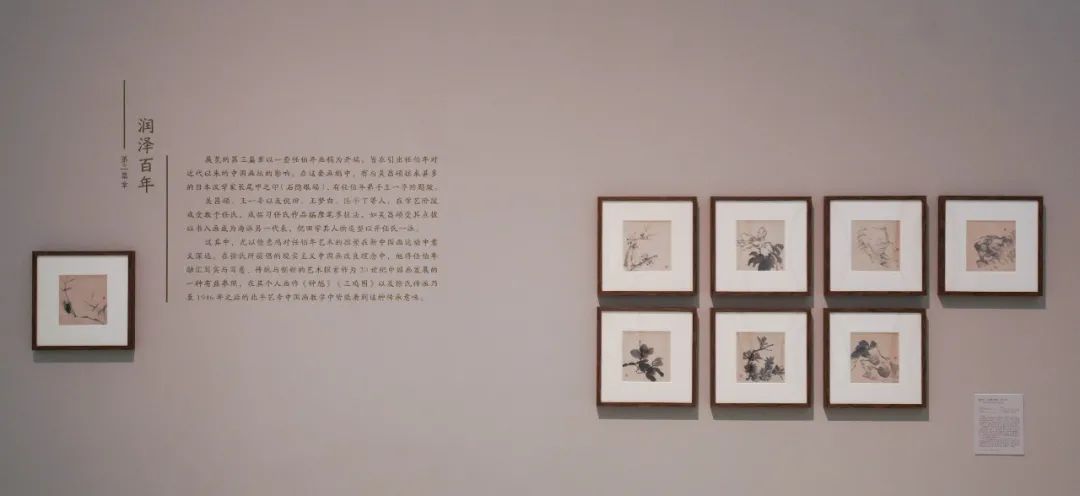
The last section “Century-old Legacy” starts with a set of Ren Bonian’s paintings, aiming to highlight Ren Bonian’s influence on the modern Chinese painting scene. In this set of sketches, there is a seal by Japanese sinologist Nagao Uzan who made friends with Wu Changshuo, and a postscript by Ren Bonian’s disciple Wang Yiting. This part presents the works of Wu Changshuo, Wang Yiting, Ni Tian, Wang Mengbai, Chen Banding and others. They were either taught by Ren or they tried to figure out ink and brush techniques in the work of Ren. For example, Wu Changshuo became another representative of the Shanghai School with his calligraphy and paintings, and Ni Tian learned his character modeling to promote the Ren’s school.
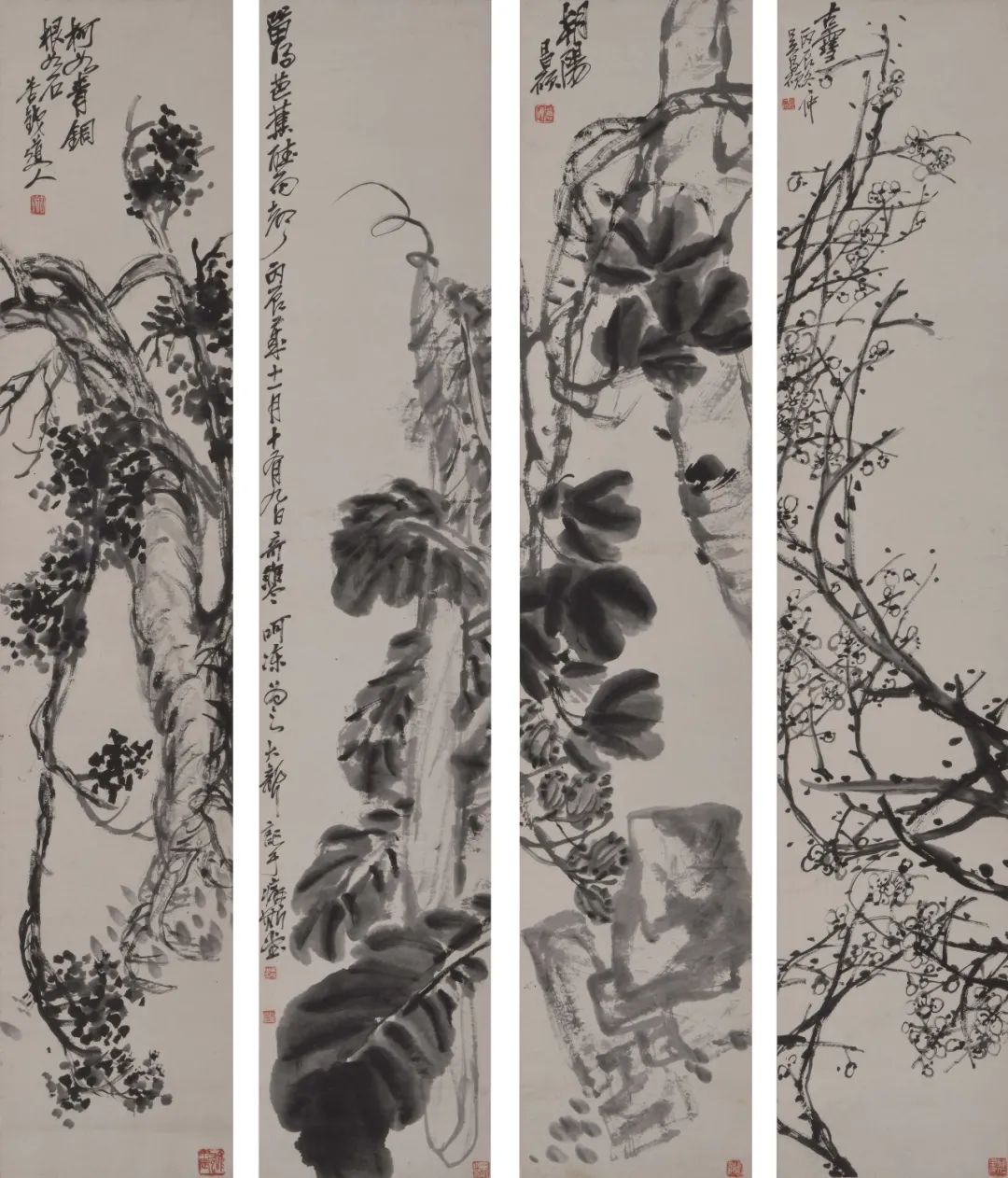
Wu Changshuo, Banana Leaves, Pine and Plum Blossom, 1916, ink on paper, 134.5× 27cm× 4
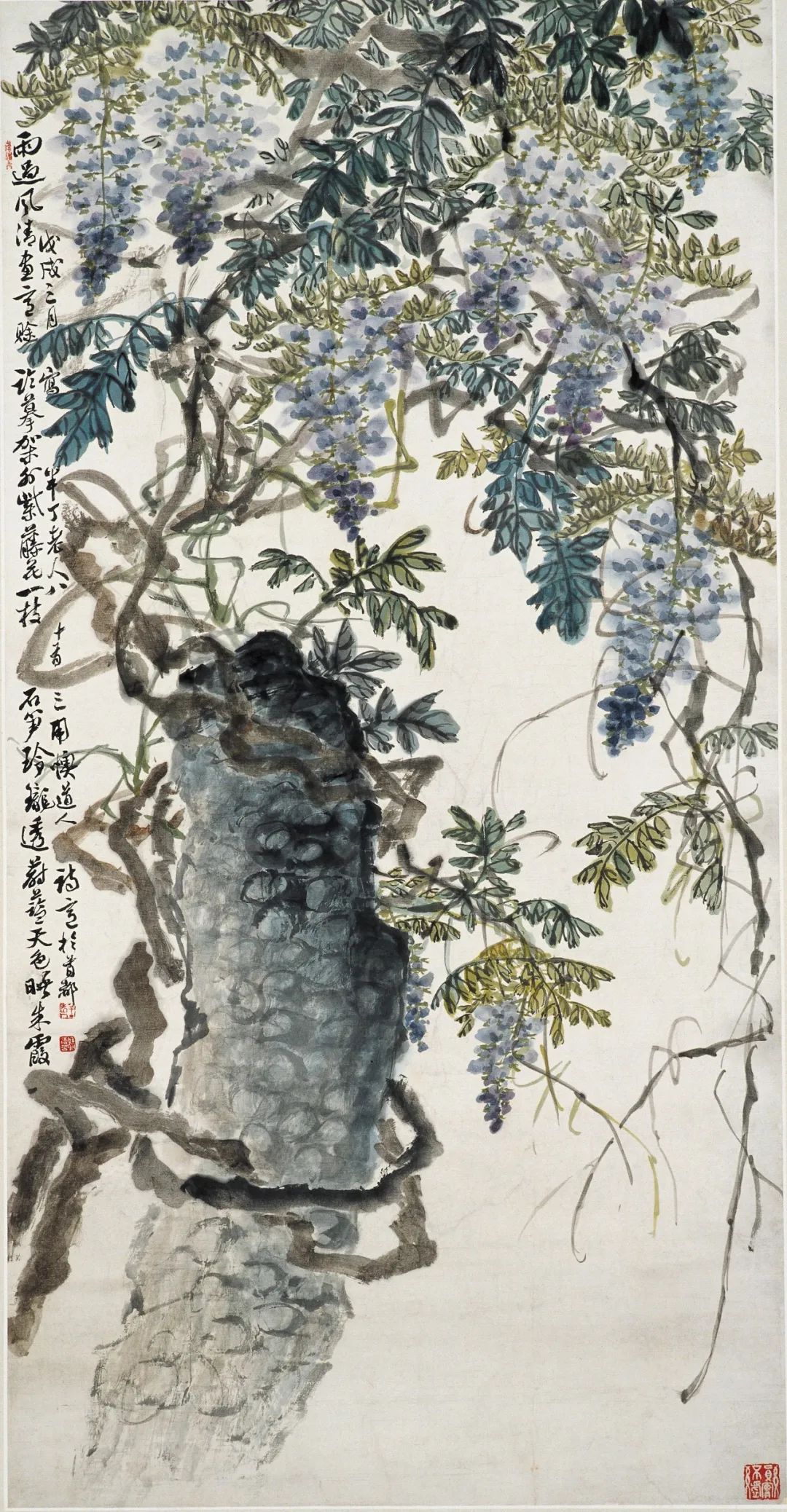
Chen Banding, Painting of Wisteria, 1958, ink and color on paper, 107 × 55cm
Xu Beihong’s admiration for Ren Bonian’s art is of far-reaching significance in the New Chinese Painting Movement. In the improvement concept of realism in Chinese painting advocated by Xu, he took Ren Bonian’s artistic exploration of combining realism with freehand brushwork, tradition with innovation as a useful reference for the development of Chinese painting in the 20th century, and brought this to his art teaching of Chinese painting in Beiping. The portrait of “Zhong Kui” displayed in the exhibition hall intuitively shows the relationship between the two modern masters of art.
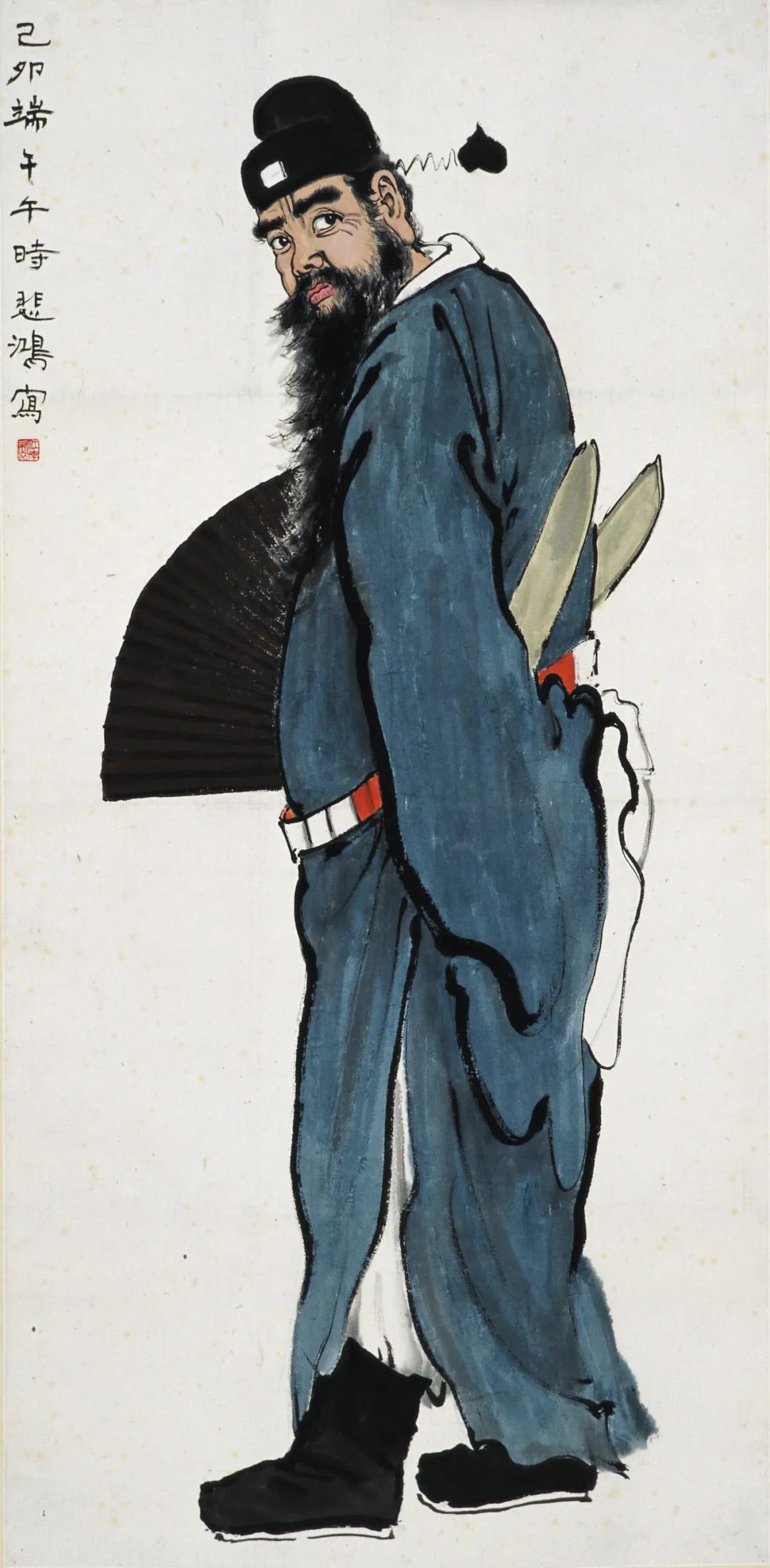
Xu Beihong, Zhong Kui, 1939, ink and color on paper, 112 ×55cm
How to look at Ren Bonian’s time-transcending accomplishment in a new light, how to inspire CAFA people and the public to learn from Ren’s work, is one of the original purposes of the exhibition. It retrospects Ren Bonian’s art against a historical background, showcasing Ren’s works in three chapters under the theme “The Versatile Master,” and reviews his accomplishments at the crossroad between ancient and modern, East and West. It is intended to portray a landscape of Chinese painting across 500 years from Ming and Qing dynasties to modern times through Ren Bonian’s art, highlighting his outstanding artistic achievement while sorting out a list of masters he had drawn inspiration from. While unraveling the logic behind CAFA’s collection of historical Chinese paintings, and the relationship between the collection and teaching of Chinese painting, the exhibition re-interprets how Ren Bonian’s works mixed traditional and modern elements and trigger the audience to think about how an individual artist pushed for a revolution in art history.
Text by Luo Yifei, ed. and trans. by Sue/CAFA ART INFO
Photo by Hu Sichen and CAFA Art Museum
Courtesy CAFA Art Museum
Exhibition View

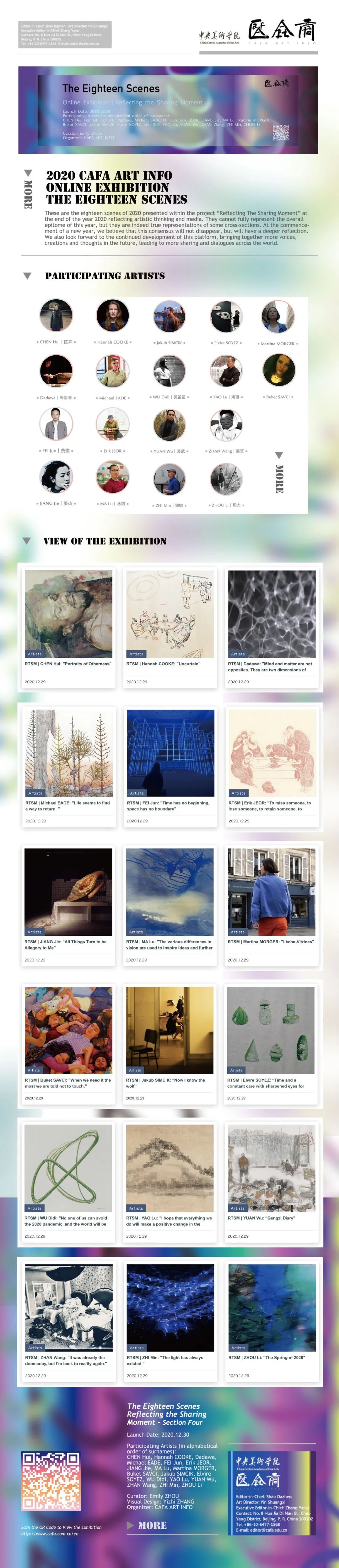
线上展览第四期"十八个现场"月刊特刊已上线
👇
免费订阅请主页对话框留言“订阅”
CAFA ART INFO
英文版
Facebook/Twitter
国际同步全部资讯
@CAFAartinfo
https://www.facebook.com/CAFAArtInfo
https://twitter.com/cafaartinfo
最新国际月刊已出
订阅请留言
版权声明:所有发表于“中央美术学院艺术资讯网CAFA ART INFO” 中英文版(http://www.cafa.com.cn) 及所属微信公众号“中央美院艺讯网”的内容均应受到国际版权条例的保护,未经授权不得擅自转载使用。
如需申请获得合作授权和内容转载许可,可后台留言“转载”,查看细则并留言联系,或邮件联系editor@cafa.edu.cn(中文)/artinfo@cafa.edu.cn (英文)。获得授权使用的转载,并注明“来源:中央美院艺讯网/CAFA ART INFO)。未经许可不得擅自转载或摘录编改文字和图片,违者本网将依法追究责任。
Copyright notice
© CAFA ART INFO, 2020. All Rights Reserved.
All of the information in the various pages of CAFA ART INFO web site and WeChat is issued by CAFA ART INFO (http://www.cafa.com.cn) for public distribution. It is protected under international conventions and under national laws on copyright. For application of cooperative authorization and reproduction permission, please contact editor@cafa.edu.cn(CN)/artinfo@cafa.edu.cn(EN). Any use of information in the web site or WeChat updates should be accompanied by an acknowledgement of CAFA ART INFO as the source, citing the uniform resource locator (URL) of the article. Unlawful copying and re-using parts of our copyright protected texts and images will result in legal action.
——TRAVEL WITH ART——

为使真正的艺术爱好者能够有机会深入了解展览、作品、艺术家及背后的故事,CAFA艺讯网启动全新项目「TRAVEL WITH ART」,联合众多著名策展人、艺术家、设计师、建筑师、人文学者等一同为大家呈现多元的线上&线下艺术活动!
后台回复“看展”即可获取更多信息,加入艺讯友邻群。
For genuine art lovers who would like to know more about exhibitions, artworks, artists as well as stories behind them, CAFA ART INFO initiates a brand new project to invite you to visit exhibitions.
-
阅读原文
* 文章为作者独立观点,不代表数艺网立场转载须知
- 本内容由数艺网主动采集收录,信息来源为 “中央美院艺讯网” 公开网络发布内容。第三方如需转载本内容,必须完整标注原作者信息及 “来源:数艺网”,严禁擅自篡改、删减或未标注来源转载。 并附上本页链接: 若您的内容不希望被数艺网收录,或认为此举侵犯了您的合法权益,敬请通过微信 ID:d-arts-cn 联系数艺网。我们将致以诚挚歉意,并第一时间为您办理下架或删除处理。
-
-
北京
甲方 · 公立学校
未认证的机构号
最近发布
-
2024-11-28
-
2024-01-29