- 0
- 0
- 0
分享
- 数据和技术让户外媒体效果越来越被客户认同!
-
原创 2021-11-03


1 9
0 2
下文收录于《亚洲户外》
2019年02月刊
户外媒体适用技术纵览
An Overview of OOH and Technology
Nancy Fletcher
美国户外广告协会总裁兼 CEO
户外媒体这一世界上最古老的广告媒介,正在经历巨大变革。
户外媒体的蓬勃发展,得益于对实际地理位置的所有权,以及伴随这些位置与生俱来的不断增长的受众。
不论静态还是数字的户外广告收入都在增长。现在美国户外广告总收入的 23% 来源于数字户外广告 ( 据 MAGNA的数据 ),而这个比例在未来只会增加。在英国和澳大利亚,数字户外广告收入目前占户外广告总收入的 50% 以上。
• 户外媒体库存有限,但需求却日益增加——这推高户外媒体的价值。
• 消费者的流动性更强:他们出外四处走动,醒着的时间 70% 以上都花在户外,消费着内容和广告。
• 户内广告在减少,且呈现碎片化的趋势。
• 户外媒体功能的扩展为户外带来了巨大的转变,使户外广告的形式变得更高效、更具吸引力,并从数字、数据和技术角度提供了比以往更多的支持。
• 并且,伴随更多户外媒体库存从静态变为数字,我们可以轮播更多的广告,利用更多的动态形式,户外媒体的创收潜力也将随之提升。
考虑到所有这些因素,许多品牌尤其是数字品牌对户外广告的兴趣与日俱增就不足为奇了。
很明显,户外媒体技术不仅仅是新奇事物。“数字”和“技术”不再是户外媒体的修饰词或属性,而是该行业及其产品不可分割的组成部分。户外媒体正从历史上缺乏数据的。
媒介转变为投入到大数据革命的媒介。户外媒体的发展渐入佳境,将逐渐成为真正由数据驱动的媒体。数据是户外媒体的一个重要的价值推动者。拥有数据,户外媒体将通过调整三个关键因素——目标定位、分析和自动购买——来实现增长,这三个因素近年促成数字媒体的爆炸式增长。如今,数字广告几乎占美国广告支出的一半。
在不断变化的世界中,户外广告的成功始于数据和技术的连锁应用。以下是户外媒体中最常见技术的简要概述。所有这些技术在某种形式上都依赖于数据,并且都是为了提高户外媒体的收入。

数据的使用总体可分为三大类或用途:
• 为测量——定义户外广告的受众
• 为定位——将户外广告活动的受众细分为独立的群体
• 为归因——证明户外广告触达这部分受众群
再将数据与技术结合起来
• 在业务系统和平台上——使户外广告更容易规划和购买
• 用于扩散和参与——扩展户外媒体的功能及传播机会。
测 量
品牌商和代理商想知道他们的钱花在了哪里、怎么花以及为什么花。
自 1933 年以来,Geopath 一直在为户外广告的受众测量制定行业标准。现在,一周曝光次数,包括可见性等因素充当了户外媒体行业的通行标准,这一标准由广告主、代理商和户外媒体公司组成的三方管理委员会认可并通过。新的测量方法很快会出现,将会使用实时匿名收集的移动数据 ( 和其他数据 ) 更准确的量化目标受众与户外广告的互动方。Geopath 定期添加新的受众画像和洞察文件,供你的本地零售客户了解他们最频繁客户的通勤模式。
很快,MRC( 媒体评估委员会 ) 将为所有户外媒体制定通用的测量标准、定义和协议,以便更好地进行媒体比较和评估。
定 位
市场营销人员已经将他们的策略从针对尽可能多的人群转向针对特定受众群体中尽可能多的人群。独立的技术和调研公司从多种渠道收集数据,并对这些数据进行分析。
三个主要的受众定位技术如下:
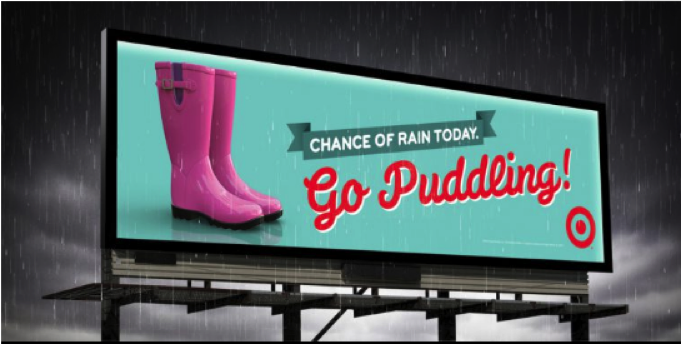
• 触发器——使用实时数据和信息,从而使户外广告消息与天气条件、时间或其他真实世界的变量同步。下雨时,Target 百货会做雨伞雨衣的广告。当花粉计数高时,你会看到药房和花粉过敏药物相关的广告。
• 地理围栏——在一个地理位置周围创建一个虚拟的地理边界。当地的汽车经销商不仅可以在自己附近的广告牌周围设置地理围栏,还可以在竞争对手的位置附近设置。
• 收集设备——用于聚合和传输数据。这些设备包括beacons、NFC 和二维码读取器、光学相机和触摸屏。
归 因
归因研究解释了广告活动的因果关系。归因研究是根据广告客户在策划广告活动时提出的目标来衡量不同 KPI 的。例如,宣传活动的 KPI 可能是社交媒体的“喜欢和分享”,也可能是商店访问量。归因指标可以通过匿名的设备 ID、生物特征识别 ( 例如面部表情和眼球追踪 )、被动或主动的电子签名收集 ( 例如信标和相机 ) 等方法来测量。
归因是户外媒体商业演变关键的下一步,因为它提供了具体的证据来证实户外广告活动产生了可量化的结果。
例如,根据 Clear Channel Outdoor 公司的归因研究,在某次户外广告活动后,北加州的本田汽车经销商展厅的参观次数增加了 80%。
业务系统和平台
如今收集到的数据量庞大,因此需要复杂的业务系统和平台来有效并高效的评估、使用这些信息。新的业务系统和平台就利用了户外媒体现在面临的数据机遇。
需要注意,现在所有的户外广告从某种形式上都是“数字的”。户外广告越来越多的受到数字交易的支持,这些数字技术用于订购、制图表、生成账单、追踪、内容投放、履约证明、创造性测试以及许多其他数字化的后台供应链元素。
行业技术专家解释了户外媒体公司如何通过开发供应方平台 (SSP) 或店面来获益。店面就是你独一无二的标识,这些平台应该由一套通用的标准、定义和协议来管理,以便户外媒体能与更广泛的广告生态系统结合到一起;否则户外媒体就会被其他媒体类型取代。
程序化
对程序化户外广告的误解一直都存在,不过这种广告销售方式正在逐渐获得推动。与“程序化数字媒体”相比, “程序化户外媒体”有四点需要了解。
• 户外媒体库存通常以“插播”或“轮播”的形式出售,而“真正的”程序化购买 ( 在数字世界中 ) 是根据基于 CPM的曝光次数来销售的。因此,数字户外广告这个词的经典用法并不一定意味着程序化户外广告。
• 户外媒体中的实时竞价 (RTB) 是有限的,因为户外媒体的供应有限,竞拍很难执行,大多数户外媒体的购买都要通过自动预留库存来保证交易。
• 精确的户外媒体数据让户外广告变得可测量,并且在某种程度上这种测量比数字媒体具有更高的一致性,但又有所不同。数字买家通过 cookie 或设备 ID 来定位单独的个体,而户外广告买家则通过聚合匿名人群的移动模式进行追踪测量。
• 第三方数据可支持动态的户外广告内容。使用诸如天气或交通等数据集,户外广告创意可以根据实时的条件进行变动。
移动设备与户外媒体相结合
许多户外媒体公司都提供移动设备来补充户外媒体活动。户外媒体与移动设备的结合提供了强大的协同效应。
户外媒体和移动设备是天然的合作对象,它们结合起来可以让品牌与他们的客户 ( 消费者 ) 建立更深入的合作关系。移动设备让户外广告能够更直接的沟通、传递更相关的信息。
移动定位与户外媒体结合使用非常有效,它可以为那些“选择加入”某个 APP 或其他交付系统的消费者提供个性化服务。可以在户外媒体位置周围设置地理围栏,这样当消费者经过地理围栏区域时,移动定位可以被“推送”到户外广告系统。
移动设备和户外媒体的结合是有效的。研究表明,当移动营销活动中添加了户外广告时,广告点阅率 (CTR) 会比行业平均水平高出 56%。而且,户外媒体被添加到媒体计划中后,可以极大地增加整个营销活动的覆盖区域。
值得一提的是,一些户外媒体公司现在将移动广告作为独立的收入来源,与其户外媒体产品分离出售。
扩散力和参与度
使用技术来定制户外广告信息可以增加消费者的感知价值,提高他们采取交易行动的可能性。
动态数字内容可以用来更换广告信息,让广告设备在恰当的时间显示最相关的内容。分时段投放就是一个很好的例子,中午 12 点,你更感兴趣的是早餐广告还是午餐广告?
Johnson’s Baby 在纽约一个繁华的购物中心制作了一个“哭泣宝宝”的互动展示广告,以探索我们大多数人都有的美好育儿本能。当你走近那个哭泣的宝宝 ( 展示在商场里的广告屏上 ) 时,他会咯咯笑出来。你一走开,他又哭了。人们会停下来参与并拍照。
未来将会怎样?
自动驾驶汽车、智慧城市将成为未来生活的一部分,人们对户外广告的兴趣浓厚。
户外媒体行业需要继续探索如何利用户外的基础设施,并更多与自动驾驶汽车和智慧城市连接。
• 我无法告诉你自动驾驶何时会全面普及,但汽车业、科技界和政府都对自动驾驶汽车给予了大力支持。自动驾驶汽车和联网汽车的出现对户外媒体行业产生了重大影响。有机会跨数字户外媒体、车载屏幕和智能手机来同步消息。
• 智慧城市的发展是由不断颠覆的技术变革来推动的,它将给城市生活的方方面面都带来巨大的变化——包括游客和居民如何沟通、消费、联络、通勤和工作。城市规划师正在寻找合作伙伴 ( 包括户外媒体合作伙伴 ),期望能提供有价值的专门技术、知识、基础设施和资金。户外媒体可以为城市和市民带来比以往更积极的影响。
除了自动驾驶汽车和智慧城市,未来人们对户外广告的兴趣也会越来越浓厚。最近的新闻证实了这一点。Netflix 从洛杉矶户外媒体公司 Regency Outdoor 购买了广告牌资产,这些广告牌将为 Netflix 独家使用。Google 成为德国户外媒体的代理商。Google 旗下的 Wave 已经成立了一个业务部门来开发户外屏幕广告。Apple 最近申请的专利车载车窗屏幕广告有可能会对户外行业产生影响。
关于人际接触与
隐私重要性的结语
有两个重要的问题不应该被忽视:人际互动的重要性以及日益增长的隐私的重要性。
首先,我们不能忘记人际互动、商业战略和创造力的重要性。数据和信息传递并不是最重要的。业务增长需要独特的、具有创造性和战略性的想法。
其次,隐私问题变得越来越重要。
户外正在从网络和移动世界的隐私错误中吸取教训 ,在这些世界里,数据的收集和使用可以说是不加选择的。现在对于户外媒体行业来说有如下一些正确的选择,这些选择可以让消费者受益,推动户外广告收入的持续增长,并为广告其它领域树立榜样。
• 在户外媒体领域,数据收集和使用的范围不仅应该限制在许可的范围内,还应该限制在运营业务所需的最低限度范围。
• 被收集和共享的位置数据应该是模糊和不精确的。
• 摄像头不应该用来识别特定的个人或车辆。
• 数据存储的时间应该尽可能短 ( 并且远远少于线上存储的 1 – 2 年标准 )。少即是多——当涉及到数据收集、数据保留和共享实践时。
• 数据的使用要完全透明。可以说,迄今为止数字广告最大的失败是长期以来以最低限度披露数据的做法。户外广告的披露标准应该高一些。这意味着需要制定一项隐私政策,清楚而详细地解释你的公司如何处理用户数据。
• 最后,户外媒体是 “一对多”的媒介,不应通过个人信息来定位特定的个体。一个户外广告可以基于宝洁总部的位置,向宝洁的 Marc Pritchard 呼唤,“嘿 Marc,这个广告是真的”,但我们不应该通过收集数据或通过设备 ID 等获取个人信息来直接针对特定个体。
现在户外媒体行业可以做出正确的选择,隐私保护将成为户外媒体的一大优势——同时伴随着户外其它的巨大优势,比如创意影响力、100% 的可见性、无欺诈或机器作弊、品牌安全、无广告拦截及其巨大价值。

OOH, the world’s oldest ad medium, is undergoing its greatest period of change.
OOH has thrived due to the ownership of physical locations plus the inherent growing audience that comes with these locations.
Both static and digital OOH revenues are growing. Digital OOH now represents 23 percent of total OOH revenue in the US (according to MAGNA), and this percentage will only increase. In the UK and Australia, digital OOH is now more than 50 percent of overall OOH revenue.
•We have a limited inventory with an increase in demand – that drives a higher value for OOH.
•Consumers are more mobile; they’re “out and about” spending more than 70 percent of waking hours outside the home, consuming content and advertising.
•Advertising inside the home is declining and fragmenting.
•Expanding OOH capabilities are driving enormous shifts to more effective and engaging forms of OOH, offering more than ever from the perspective of digital, data, and technologies.
•And, as more OOH inventory goes from static to digital, OOH revenue potential increases as more ads can be rotated in and more dynamic formats can be utilized.
Given all these factors, it’s not surprising that there’s increasing interest in OOH from many brands, and in particular from digital brands.
It is obvious then that OOH tech is more than a novelty. “Digital” and “technology” are no longer tacked-on qualifiers or attributes of OOH – but are integrated parts of the industry and its offerings. OOH is moving from being a historically data-poor medium to one that is joining the big data revolution. OOH stands at the precipice of becoming a true data-driven medium. Data is a significant value enabler for OOH. With data, OOH will grow by adapting the same three key factors – targeting, analytics, and automated buying – that have caused digital media to explode in recent years. Digital ads now represent almost half of all US advertising expenditures.
Success in the changing world of OOH starts with the interlocking use of data and tech. What follows is a brief overview of the most common tech uses for OOH. All these technologies rely on data, in some way, and all are intended to drive revenue for OOH (or why else do it?).
The use of data falls into three overall “buckets” or purposes:
•For measurement – defining an OOH audience
•For targeting – refining the OOH campaign audience as a discrete “tribe” or segment
•For attribution – proving the tribe or segment was reached with OOH advertising
The data is then combined with technology
•In business systems and platforms – making OOH easier to plan and buy
•For amplification and engagement – expanding OOH capabilities and opportunities
Measurement
Brands and agencies want to know where their money is being spent, how, and why.
Since 1933, Geopath has been setting OOH industry standards for audience measurement. Today, weekly impressions, including visibility adjustments and other elements, serve as the OOH industry currency approved by a tri-partite governance board of advertisers, agencies, and OOH media companies. There will be new measurement soon that uses real-time anonymously collected mobile data (and other sources) to more precisely and accurately quantify how target audiences engage with OOH. Geopath is regularly adding new audience profiles and insights suitesso that your local retail client can understand commuting patterns of their most frequent customers.
Soon, the Media Rating Council (MRC) will set common measurement standards, definitions, and protocols for all OOHso better media comparisons and valuations can be made.
Targeting
Marketers have shifted their strategy from targeting as many people as possible to targeting as many members of a specific audience segment as possible. Independent tech and research companies collect and analyze data from multiple sources. These companies include Airsage, Blue Bite, Board Active, Citilabs, Cuebiq, Foursquare, Gimbal, GroundTruth, PeopleCount, Pinsight, MarketTrack, and Sito, among others.
These are three of the primary targeting techniques:
•Triggers – employ real-time data and information in which OOH messages synchronize to weather conditions, time of day, or other real-world variables. When it’s raining, Target stores advertise umbrellas and raincoats. When the pollen count is high, you see pharmacy and hay fever meds.
•Geofencing – involves the creation of a virtual perimeter around a geographic location, like a billboard or a store. Not only can your local car dealer geofence around their billboards, they can geofence around competitor locations.
•Collection devices – are used to aggregate and transfer data. They include beacons, NFC and QR code readers, optical cameras, and touch screens.
Attribution
Attribution research explains the cause and effect of an advertising campaign. Attribution research measures different KPIs based on objectives outlined by an advertiser when planning an advertising campaign. For example, KPIs for a campaign might be social media “likes and shares”, or it could be store visits. Attribution can be measured by anonymous device IDs, biometrics such as facial expression, eye tracking, passive or active electronic signature collection such as beacons and cameras, along with other methods.
Attribution is the critical next step in the evolution of OOH commerce because it provides the concrete proof that an OOH campaign produced quantifiable results.
For instance, Honda auto dealers in Northern California saw an 80 percent lift in their showroom visits after an OOH campaign, according to a Clear Channel Outdoor attribution study.
Business Systems and Platforms
The data collected today is vast; therefore, sophisticated business systems and platforms are needed to efficiently and effectively evaluate and use the information. New business systems and platforms capitalize on the data opportunity facing OOH today.
Please note that all OOH is “digital” in some form today. Increasingly, OOH is powered by digital transactions for ordering, charting, billing, tracking, content delivery, proof of performance, creative testing, and many other supply chain elements that act digitally in the background.
Industry tech experts have explained how all OOH media companies benefit from the development of a Supply Side Platform (SSP) or storefront. Your storefront is your unique identity. IBO is doing so with Apparatix. These platforms should be governed by a set of common standards, definitions, and protocols so that OOH can integrate with the wider advertising ecosystem; otherwise OOH will lose out to other media types. Digital publishers (i.e. Facebook, Google, Snapchat) each provide their media offerings to the larger ecosystem using their own Supply Side Platform through a set of common principle elements. Their storefront is their unique identity.
Programmatic
There have been misconceptions about programmatic OOH, but the approach is gaining traction.Programmatic is not intended to threaten direct sales teams but introduce another tool for teams to make sales.
Four things to know about “programmatic OOH” compared to “programmatic digital” media.
•OOH inventory is often sold as “spots” or “loops” while “real” programmatic buying (in the digital world) is sold on impressions based on CPMs. Therefore, digital OOH doesn’t necessarily mean programmatic in the classic use of that term.
•There is limited Real-Time Bidding (RTB) in OOH because most OOH buys are guaranteed with inventory reserved in an automated fashion since auctions are difficult to execute because of the finite OOH supply.
•Precise OOH data makes OOH measurable in a way that’s more consistent, but different, than digital media. Digital buyers follow cookies or device IDs to target an individual, while OOH buyers follow the movement patterns of aggregated and anonymous groups of people (or tribes).
•Third-party data allows for dynamic OOH content. The use of datasets like weather or traffic allows OOH creative to change based on real-time conditions.
Combining Mobile with OOH
Many OOH media companies are offering mobile to complement OOH campaigns. Working together, OOH and mobile provide powerful synergies.
OOH and mobile are natural partners and allow brands to forge a greater partnership with their customers (consumers). Mobile phones allow OOH ads to communicate more directly and deliver more pertinent messages.
Mobile targeting, used in combination with OOH, is effective and can be personalized for those consumers “opting in” to an app or other delivery system. OOH locations can be geofenced so that mobile targeting can be “pushed” as consumers pass a geofenced zone.
Mobile and OOH together are effective. Research has shown that click-through rates (CTRs) rise +56 percent above the industry average when OOH is added to a mobile campaign. And, when OOH is added to a media plan, it can dramatically increase the reach of the overall campaign.
It’s also worth mentioning that some OOH media companies are now selling mobile advertising as a separate revenue source, discrete from their OOH media offerings.
Amplification and Engagement
Brands are enhancing OOH campaigns with tech that makes the advertising more engaging, relevant, and personal for consumers by using artificial intelligence (AI), augmented reality, optical devices, touch screens, triggers, and more.
Artificial intelligence, like Apple’s Siri and Amazon Alexa, simulates the thinking power of a human.
Automated buying platforms can work the same way. Augmented reality took center stage a few years ago when Pokémon Go was a fad. By looking through a mobile device, animated characters appeared to interact in the real world. OOH campaigns, for instance for Mercedes-Benz cars, have used similar technology making elements literally pop off an OOH board when viewed through a mobile device.
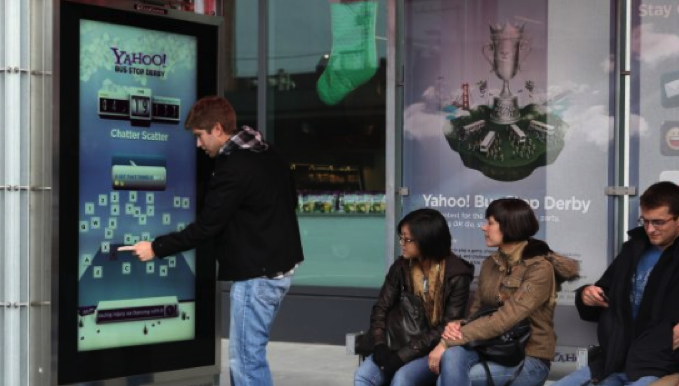
Touchscreens, like an iPad screen, are interactive. This type of tech has been applied to some bus shelters, mall ads, airport displays, and other pedestrian formats, greatly increasing consumer engagement with a brand. You may have seen the MTA and Amazon campaign that brought holiday shopping to consumers underground on OOH kiosks. There are now hundreds of examples of interactive OOH campaigns with pedestrian formats.
Using technology to customize OOH messaging increases the perceived value to the consumer and heightens their probability of action.
Dynamic digital content can be used to change messages presenting the most relevant content at the right time. Dayparting is a perfect example. At 12 noon, are you more interested in seeing an ad for breakfast or lunch?
Johnson’s Baby created an interactive “Crying Baby” display ad in a busy mall in NYC to explore the beautiful parenting instinct that most of us have. When you approached the crying baby (featured on the mall display) he would smile and giggle. When you walked away, he would cry again. People stopped, engaged, and took photos.
What about the Future?
The future will include autonomous vehicles, Smart Cities, and an intensified interest in OOH.
The OOH industry needs to continue to explore how it can use the OOH infrastructure and connect more with autonomous vehicles and Smart Cities.
•I can’t tell you when there will be a full roll-out, but there is significant support for autonomous vehicles across the auto industry, the tech world, and government. The emergence of autonomous vehicles and connected cars has major implications for the OOH industry. Opportunities exist to synchronize messages across digital OOH, in- vehicle screens, and smartphones.
•The Smart Cities movement, driven by the ongoing avalanche of technology transformation, will result in big changes to nearly every aspect of city living – including how visitors and residents communicate, consume, connect, commute, and work. City planners are looking for partners (including OOH partners) to provide valuable expertise, knowledge, infrastructure, and funding. OOH can be turned into an even more positive force for cities and citizens than it has been in the past.
In addition to autonomous vehicles and Smart Cities, the future will hold an intensified interest in OOH. Recent news stories prove this point. Netflix bought billboard assets from Regency Outdoor in Los Angeles that it will use exclusively for its own advertising. Google is acting as a reseller of German OOH. Wave (owned by Google) has formed a business unit to develop onscreen advertising positioned as OOH. Apple’s recent patent for in-car window screen ads could have implications for OOH.
Final Thoughts on the Importance of the Human Touch and the Importance of Privacy
There are two important final thoughts that shouldn’t be overlooked: the importance of human interaction and the increasing importance of privacy.
First, we can’t forget about the importance of human interaction, business strategy, and creativity. Data and message delivery aren’t the be-all and end-all. Business growth requires distinctive, creative, and strategic ideas.
Second, privacy concerns are becoming increasingly important
•In OOH, the scope of data collection and use should be limited not merely to what is allowed, but to what is allowed and minimally required to operate your business.
•Location data, if collected and shared, should be obfuscated and imprecise.
•Cameras should never be used to identify specific individuals or vehicles.
•Data should be stored for the bare minimum of time necessary (and far less than the one-to-two-year standard for online). Less is more – when it comes to data collection, retention, and sharing practices.
•Be fully transparent with your data practices. Arguably the biggest failing of digital advertising to date has been the longstanding practice of disclosing data to the minimum degree required. The OOH bar needs to be higher. That means creating a privacy policy that explains, clearly and in detail, what your company does with user data.
•Finally, OOH is a “one-to-many” medium and should not target specific individuals via personal information. An OOH ad may call out Marc Pritchard of P&G (based on the location of P&G headquarters) with a message that says, “Hey Marc, This Ad is Real,” but we shouldn’t directly target specific individuals using data collection or by accessing personal information such as device IDs.
The OOH industry can make the right choices now and privacy protection will be an OOH advantage – to go along with other big OOH advantages such as creative impact, 100 percent viewability, no fraud or bots, brand safety, no ad blocking, and great value.

特刊醒目位置 特别鸣谢 与标杆企业列席
* 仅限20家标杆企业( 20个细分领域每个领域排他性只选1家)
2、荣誉联合发行单位
特刊内固定位置鸣谢
*限量100家 头部企业



长按识别二维码
定制特刊






-
阅读原文
* 文章为作者独立观点,不代表数艺网立场转载须知
- 本内容由数艺网主动采集收录,信息来源为 “AOM亚洲户外” 公开网络发布内容。第三方如需转载本内容,必须完整标注原作者信息及 “来源:数艺网”,严禁擅自篡改、删减或未标注来源转载。 并附上本页链接: 若您的内容不希望被数艺网收录,或认为此举侵犯了您的合法权益,敬请通过微信 ID:d-arts-cn 联系数艺网。我们将致以诚挚歉意,并第一时间为您办理下架或删除处理。
-

-
上海
总包方 · 广告/活动策划
未认证的机构号
最近发布
-
2024-01-15
-
2024-01-12