- 0
- 0
- 0
分享
- 重磅!博物馆的最新定义公布!
-
2022-08-25
北京时间8月24日,国际博物馆协会官网发布信息,正式公布了博物馆的新定义,此前提交的提案B获得通过。
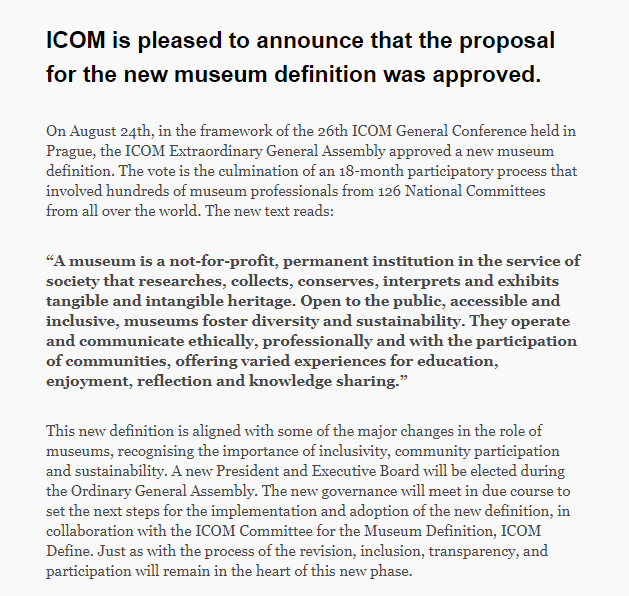
ICOM 很高兴地宣布新博物馆定义的提案获得批准。
“A museum is a not-for-profit, permanent institution in the service of society that researches, collects, conserves, interprets and exhibits tangible and intangible heritage. Open to the public, accessible and inclusive, museums foster diversity and sustainability. They operate and communicate ethically, professionally and with the participation of communities, offering varied experiences for education, enjoyment, reflection and knowledge sharing.”
The word of museum here denotes any permanent establishment,administered in the general interest,for the purpose of preserving,studying,enhancing by various means and,in particular,of exhibiting to the public for its delectation and instruction groups of objects and specimens of cultural value:artistic,historical,scientific and technological collections,botanical and zoological gardens and aquariums.Public libraries and public archival institutions maintaining permanent exhibition rooms shall be considered to be museums.
ICOM shall recognise as a museum any permanent institution which conserves and displays,for purposes of a study,education and enjoyment,collections of objects of cultural or scientific significance.
Within this definition fall:
a. exhibition galleries permanently maintained by public libraries and collections of archives,
b. historical monuments and parts of historical monuments or their dependencies, such as cathedral treasuries, historical, archaeological and natural sites, which are officially open to the public,
c. botanical and zoological gardens, aquaria, vivaria, and other institutions which display living specimens,
d. natural reserves.
A museum is a non-profit making, permanent institution in the service of the society and its development,and open to the public,which acquires,conserves,researches,communicates,and exhibits, for purposes of study,education and enjoyment, material evidence of man and his environment.
In addition to museums designated as such, ICOM recognizes that the following comply with the above definition:
a. conservation institutes and exhibition galleries permanently maintained by libraries and archive centres.
b. natural, archaeological, and ethnographic monuments and sites and historical monuments and sites of a museum nature, for their acquisition, conservation and communication activities.
c. institutions displaying live specimens, such as botanical and zoological gardens, aquaria, vivaria, etc.
d. nature reserves.
e. science centres and planetariums.
A museum is a non-profit making,permanent institution in the service of society and its development,and open to the public which acquires,conserves,researches,communicates and exhibits,for purposes of study,education and enjoyment,material evidence of people and their environment.
The above definition of a museum shall be applied without any limitation arising from the nature of the governing body, the territorial character, the functional structure or the orientation of the collections of the institution concerned.
In addition to institutions designated as "museums" the following qualify as museums for the purposes of this definition:
i. natural, archaeological and ethnographic monuments and sites and historical monuments and sites of a museum nature that acquire, conserve and communicate material evidence of people and their environment;
ii. institutions holding collections of and displaying live specimens of plants and animals, such as botanical and zoological gardens, aquaria and vivaria;
iii. science centres and planetaria;
iv. conservation institutes and exhibition galleries permanently maintained by libraries and archive centres;
v. nature reserves;
vi. such other institutions as the Executive Council, after seeking the advice of the Advisory Committee, considers as having some or all the characteristics of a museum, or as supporting museums and professional museum workers through museological research, education or training.
A museum is a non-profit making permanent institution in the service of society and of its development,and open to the public which acquires,conserves,researches,communicates and exhibits,for purposes of study,education and enjoyment,material evidence of people and their environment.
The above definition of a museum shall be applied without any limitation arising from the nature of the governing body, the territorial character, the functional structure or the orientation of the collections of the institution concerned.
In addition to institutions designated as "museums" the following qualify as museums for the purposes of this definition:
i. natural, archaeological and ethnographic monuments and sites and historical monuments and sites of a museum nature that acquire, conserve and communicate material evidence of people and their environment;
ii. institutions holding collections of and displaying live specimens and plants and animals, such as botanical and zoological gardens, aquaria and vivaria;
iii. science centres and planetaria;
iv. conservation institutes and exhibition galleries permanently maintained by libraries and archive centres;
v. nature reserves;
vi. international or national or regional or local museum organisations, ministries or departments or public agencies responsible for museums as per the definition given under this article;
vii. non-profit institutions or organisations undertaking research, education, training, documentation and other activities relating to museums and museology;
viii. such other institutions as the Executive Council, after seeking the advice of the Advisory Commitee, considers as having some or all of the characteristics of a museum, or as supporting museums and professional museum workers through museological research, educaton or training.
A museum is a non-profit making,permanent institution in the service of society and of its development,and open to the public,which acquires,conserves,researches,communicates and exhibits,for purposes of study,education and enjoyment,material evidence of people and their environment.
a. The above definition of a museum shall be applied without any limitation arising from the nature of the governing body, the territorial character, the functional structure or the orientation of the collections of the institution concerned.
b. In addition to institutions designated as "museums" the following qualify as museums for the purposes of this definition:
i. natural, archaeological and ethnographic monuments and sites and historical monuments and sites of a museum nature that acquire, conserve and communicate material evidence of people and their environment;
ii. institutions holding collections of and displaying live specimens of plants and animals, such as botanical and zoological gardens, aquaria and vivaria;
iii. science centres and planetaria;
iv. non-profit art exhibition galleries;
v. nature reserves;
vi. international or national or regional or local museum organisations, ministries or departments or public agencies responsible for museums as per the definition given under this article;
vii. non-profit institutions or organisations undertaking conservation, research, education, training, documentation and other activities relating to museums and museology;
viii. cultural centres and other entities that facilitate the preservation, continuation and management of tangible or intangible heritage resources (living heritage and digital creative activity);
ix. such other institutions as the Executive Council, after seeking the advice of the Advisory Committee, considers as having some or all of the characteristics of a museum, or as supporting museums and professional museum personnel through museological research, education or training.
-
阅读原文
* 文章为作者独立观点,不代表数艺网立场转载须知
- 本内容由数艺网主动采集收录,信息来源为 “文博圈” 公开网络发布内容。第三方如需转载本内容,必须完整标注原作者信息及 “来源:数艺网”,严禁擅自篡改、删减或未标注来源转载。 并附上本页链接: 若您的内容不希望被数艺网收录,或认为此举侵犯了您的合法权益,敬请通过微信 ID:d-arts-cn 联系数艺网。我们将致以诚挚歉意,并第一时间为您办理下架或删除处理。
-

-
北京
甲方 · 垂直媒体
未认证的机构号
最近发布
-
2024-07-08
-
2024-07-03