- 0
- 0
- 0
分享
- Beyond Immersion
-
09-26
Beyond Immersion
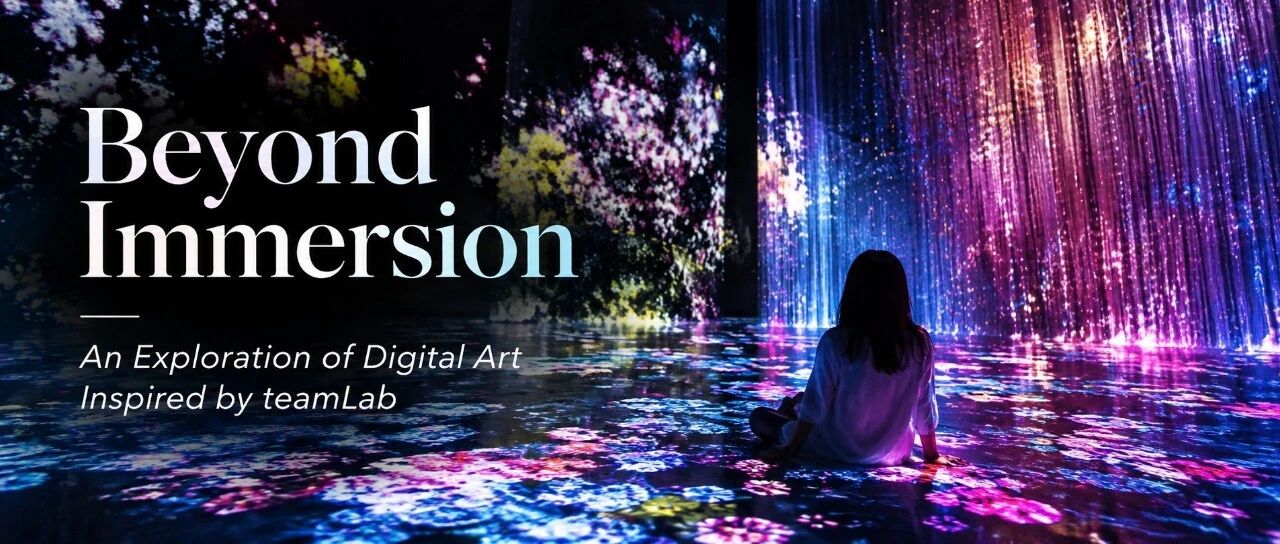
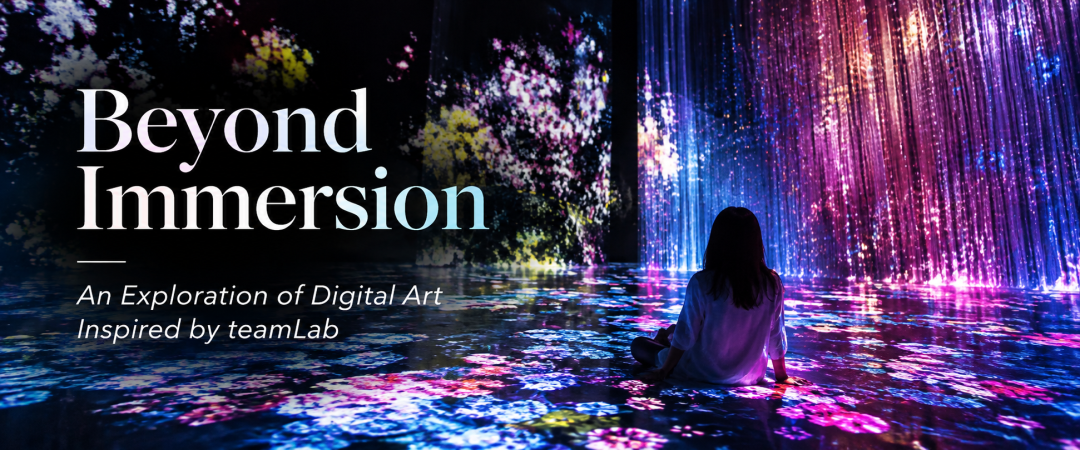
An Exploration of Digital Art Inspired by teamLab
For as long as I can remember, I’ve always been drawing. My obsession with drawing was apparently too promising to be left alone. Before long, I was enrolled in sketching, oil painting, traditional Chinese painting—you name it. Along with the art classes came regular visits to museums and galleries, where paintings hung quietly on the walls and sculptures stood behind glass. I appreciated those experiences, but they never drew me in quite the same way.
As I grew older, I found myself gravitating toward digital forms of creativity. I moved from sketching on paper to creating illustrations on screen, and, more recently, exploring AI-generated images and videos. At the time, I thought digital art simply meant creating art with digital tools.
That was until I visited teamLab during a trip to Tokyo. I expected to enjoy the exhibition; what I didn’t expect was that it would challenge a definition I had never questioned before.
The first space I entered was a narrow path covered with water, leading toward a glowing waterfall. As I stepped into the cold water, I realized I was no longer standing in front of an artwork. I was inside it. The water, the light, the sound, and even my own body all became part of the artwork.
That feeling only grew stronger as I moved through the exhibition.
In The Infinite Crystal Universe, mirrored walls reflected countless strands of light from top to bottom until I could no longer tell where the artwork ended—or whether it ended at all.
In Catching and Collecting Forest, the projected animals only came alive through visitors interacting with them using their phones. For the first time, my phone was no longer a camera—it had become part of the creative process.
The boundary between artwork and audience seemed to dissolve.
The experience stayed with me long after I left Tokyo. I realized that my understanding of digital art had been far too narrow, and I began to question what I really meant by “digital art.” For years, I had defined digital art by the tools used to create it. What teamLab revealed was that its real innovation lay elsewhere.
At first, I assumed TeamLab’s innovation lay in its technology: software, projectors, sensors, and code that made the installations possible. What stayed with me, however, was how effortlessly it had faded into the background. Rather than showcasing the technology itself, it quietly immersed them in the experience.
As the technology became almost “invisible”, the experience came into focus. Instead of standing outside the artwork and simply observing it, the audience was invited to step inside it, interact with it, and shape it through their own presence; the artwork no longer felt separate from its audience, it seemed to come alive through participation. I began to realize that digital art was changing the relationship between artwork and audience.
The more I thought about it, the more I realized that every era reshapes the relationship between people and art. The Impressionists became fascinated by light because modern life had transformed the way people saw the world. Chinese landscape painters expressed harmony between humanity and nature because it reflected the philosophy of their time. Every generation develops its own artistic language in response to the world it inhabits.
I grew up in a world shaped by the internet, smartphones, AI, and interactive technology. From an early age, I was used to clicking, swiping, editing, experimenting, and responding. Looking back, I realized that creating digitally had always felt natural to me. Perhaps I had been speaking the artistic language of my own generation all along without realizing it.
But what truly drew me to digital creation was something more. It wasn’t the technology itself, or even the freedom it gave me to create. It was the feeling that a creation never had to end where it began. A drawing was rarely just a drawing, it could become a character. That character might inspire a story, and that story could gradually grow into an entire world. Every new drawing or piece of writing didn’t replace the last one—it expanded what already existed. Rather than completing a single image, I found myself building something that continued to grow over time.
One small example is the way I create characters based on their MBTI personality types. I often determine their MBTI before I start, then imagine how those four letters might bind with each fictional character. I think about their clothing, expressions, gestures, and all the little details that might reflect who they are based on their personality. This way of thinking gradually extended beyond drawing. At first, I simply enjoyed exploring the worlds that other people had created through games. Before long, though, I found myself wanting to build worlds of my own. I began designing characters, settings, storylines, and even the rules that governed how those worlds worked.
The same thing happened with my own artwork. I rarely leave a picture as a single, static image. I might add a storyline, turn it into an animation, and pair it with music that captures the mood I imagined. What begins as a drawing can continue to evolve across different forms. Looking back, I realized that I was never interested in creating isolated works. I was always drawn to creations that could continue to grow, transform, and connect with one another.
I also realized that my visit to teamLab had revealed another possibility. For the first time, I encountered creative work that felt far beyond what any one person could create alone.
Creating works like those at teamLab requires far more than artistic talent. Unlike a painter working independently in a studio, digital artists collaborate with programmers, engineers, designers, architects, and technicians. The final experience feels seamless, yet behind it lies an extraordinary amount of coordination across different disciplines, each contributing its own way of thinking toward a shared vision.
That realization expanded my understanding of creativity. Until then, I had mostly imagined creativity as something personal—a drawing, a story, or a short animation made by one individual. teamLab challenged that assumption. I began to see collaboration not simply as dividing the work, but as a way of creating ideas that no single person could have imagined alone. It made me wonder whether the most exciting ideas emerge from conversations between different disciplines.
Yet the more I reflected on interaction, the more I realized that not all interaction is equally meaningful.
At teamLab, I noticed that many visitors spent more time photographing the installations than experiencing them. There was nothing wrong with wanting to preserve the moment—I took photos myself. Yet I couldn’t help wondering whether interaction had, at times, become another form of consumption. Were we exploring the artwork, or simply collecting images of ourselves inside it? The technology had become almost invisible, making the experience feel effortless. But that very effortlessness also made me wonder how often people paused to think about the ideas, engineering, and artistic decisions that made those experiences possible.
That question stayed with me as I visited other exhibitions described as “immersive.” Some projected the paintings of long-dead artists onto enormous walls, surrounded them with music and animation, and invited visitors to walk through them. The technology was impressive, but it seemed to transform only the presentation, not my relationship with the artwork itself. I realized that although I had participated in the experience, I hadn’t necessarily understood the artwork any differently. Technology can invite participation, but participation alone does not necessarily create a meaningful relationship between the audience and the artwork.
I don’t know where digital art will go next, and I suspect no one really does. The technology will continue to evolve, new forms of creativity will emerge, and new questions will inevitably follow. Perhaps digital art still has a long way to go. Then again, perhaps so do I. For now, I am simply grateful that one visit to teamLab taught me that the most interesting questions are often the ones that remain unanswered—and that is reason enough for me to keep exploring.
Acknowledgements
This essay was inspired by my visit to teamLab Planets and teamLab Borderless in Tokyo. During the writing process, I closely read two essays on digital art and immersive experiences:
Tom Uglow, The arts electric (Aeon)
Anna Wiener, The Rise of “Immersive” Art (The New Yorker)
These essays helped shape my thinking about digital art, though the reflections and conclusions presented here are entirely my own.
I also used AI as a writing partner to discuss ideas, compare wording, and revise drafts. All personal experiences, arguments, and final editorial decisions remain my own.
-
阅读原文
* 文章为作者独立观点,不代表数艺网立场转载须知
- 本内容由数艺网主动采集收录,信息来源为 “TECI Notes” 公开网络发布内容。第三方如需转载本内容,必须完整标注原作者信息及 “来源:数艺网”,严禁擅自篡改、删减或未标注来源转载。 并附上本页链接: 若您的内容不希望被数艺网收录,或认为此举侵犯了您的合法权益,敬请通过微信 ID:d-arts-cn 联系数艺网。我们将致以诚挚歉意,并第一时间为您办理下架或删除处理。